



Most creators sign with an agency because of the headline number: "we take 30%." Then a year later they are still not sure where the money went. The commission percentage is only the visible layer. Underneath it sits the platform's own cut, a set of extra charges that rarely make the sales pitch, and contract language that can cost more than the split itself.
This is a due-diligence guide for the creator side of the table. It covers how agency fees stack on top of what OnlyFans already keeps, the five ways agencies actually price their work, the fees that hide below the commission line, and the contract clauses that quietly move money away from you. Every number here is a market range or a rule of thumb, not a fixed law, so use it to interrogate a specific offer rather than to memorize one "correct" rate.
Key takeaways
- OnlyFans keeps 20% of your gross before an agency touches anything. A 30% agency deal on gross leaves you with 50 cents on the dollar; a 50% deal leaves you with 30 cents.
- The industry has settled around 30% for full-service management. Budget shops sit at 10 to 25%, premium at 40 to 50%, and anything above 50% needs an exceptional justification almost no agency can honestly give.
- Whether commission is charged on gross or on your post-platform net is worth roughly $7,200 a year on a $10,000-a-month page. Get it in writing.
- The fees that hurt are usually not the split. They are setup charges, add-on line items, chargeback liability, collaboration commissions, and commission on subscribers you already had.
- A 2026 BBC investigation put the worst end of this market on the record: some UK agencies taking up to 70% while holding passwords and penalizing exit. The findings double as a checklist of terms to refuse.
The real math: two cuts, not one
Before you weigh any agency's rate, get clear on the layer beneath it. OnlyFans takes a flat 20% of everything a page earns, applied automatically before a payout ever reaches you. Earn $100 in subscriptions, tips, and pay-per-view, and $80 lands in your pending balance. That cut does not change with volume, and no agency can negotiate it away, so it is the fixed floor under every calculation that follows.
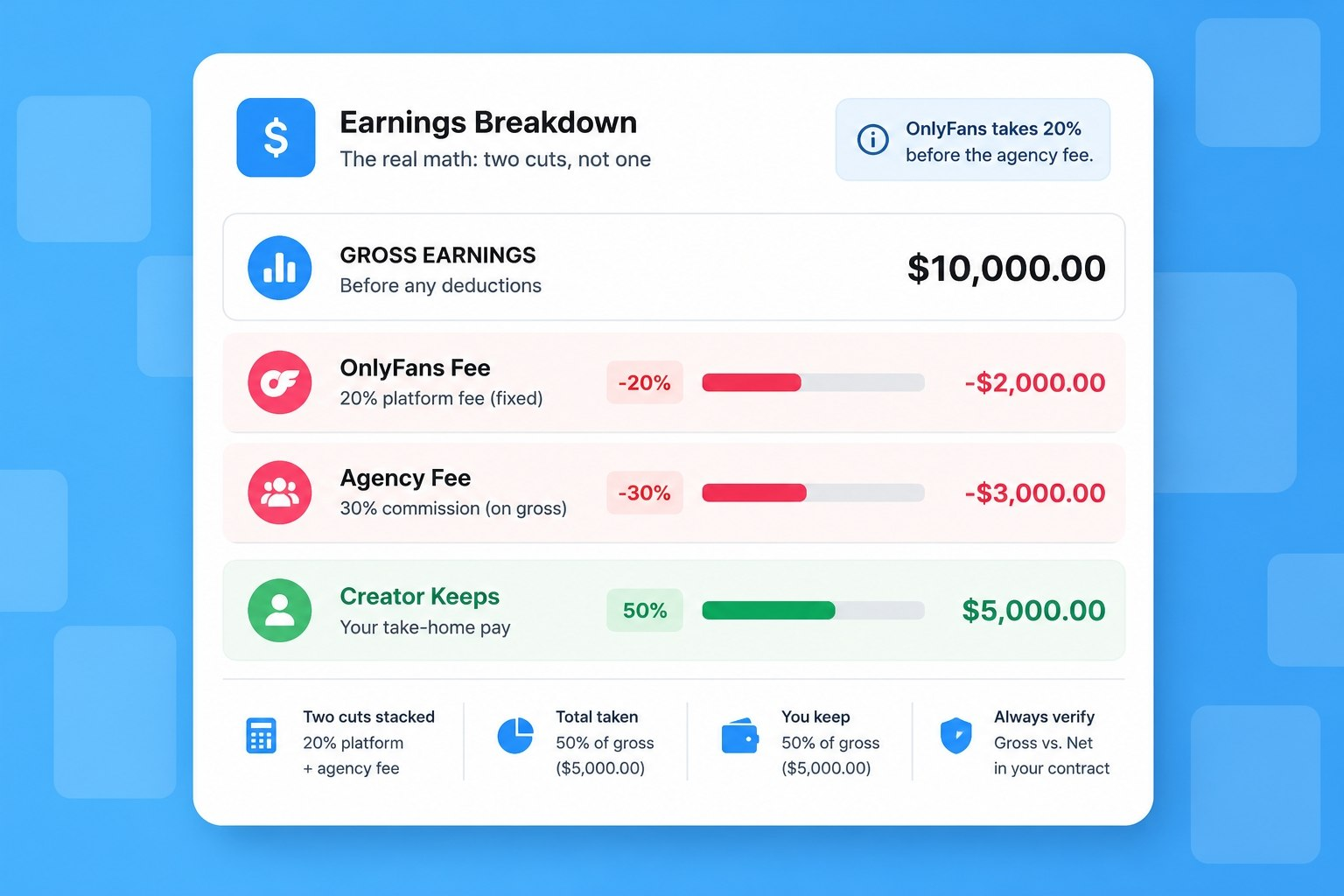
An agency commission stacks on top of that floor. Say a page grosses $10,000 in a month with a 30% agency deal charged on gross:
- OnlyFans takes 20% of $10,000 = $2,000
- The agency takes 30% of $10,000 = $3,000
- You keep $5,000
So a "30% agency" is really a 50% total cut once the platform is counted. Push the agency share to 50% of gross and the arithmetic gets stark: $2,000 to the platform, $5,000 to the agency, $3,000 to you. That is the 30-cents-on-the-dollar figure a June 2026 BBC investigation attached to the worst contracts it reviewed, where management fees reached as high as 70% on top of the platform cut.
None of this makes a 50% total cut automatically a bad deal. It makes it a deal that only works if the agency is generating far more than you would alone. The math section later in this guide shows how to test that. The point for now is that you are always evaluating two cuts stacked together, and the one you negotiate is the smaller layer sitting on a fixed 20% base.
The five ways agencies price their work
"How much do you charge" has more than one answer, because agencies use at least five distinct fee structures. The percentage means different things under each, and the right one depends far more on your monthly revenue than on which sounds generous.
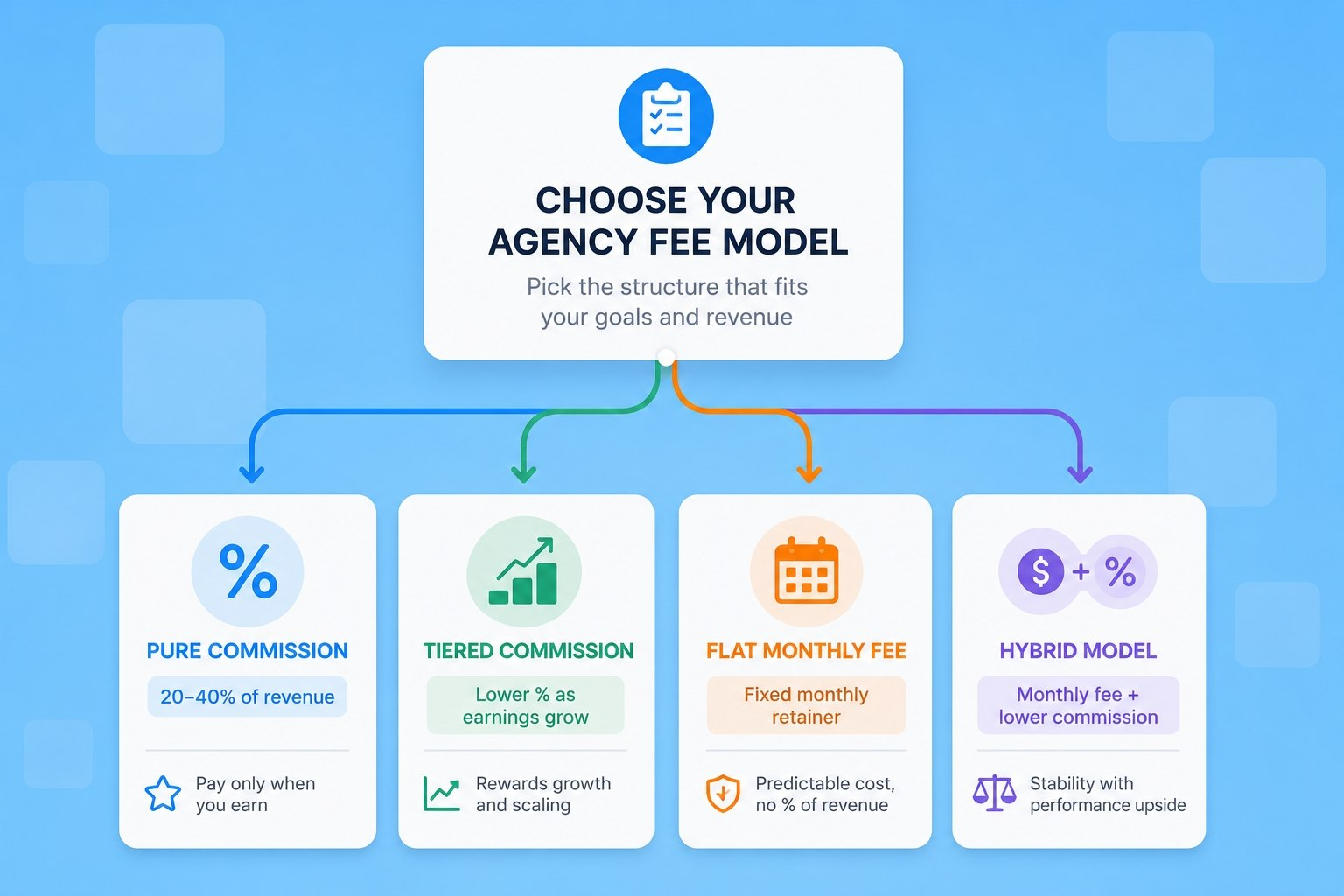
Pure commission is the default: a flat percentage of gross earnings, usually 20 to 50%, with no upfront cost. Incentives line up because the agency earns only when you do, and it scales cleanly. The downside shows up at the top: 30% of a $50,000 month is $15,000, and at that level a fixed arrangement often costs less. Best fit is a newer creator who cannot risk paying before results arrive.
Tiered commission lowers the percentage as you earn more, for example 40% under $5,000 a month, 35% from $5,000 to $20,000, 30% from $20,000 to $50,000, and 25% above that. It rewards growth and treats high earners more fairly, at the cost of a steeper rate while you are small and more complicated tracking when a month straddles two tiers.
Flat monthly fee replaces the percentage with a fixed retainer, commonly $500 to $5,000 a month regardless of what the page earns. Predictable, and a clear win for established creators: a $2,000 retainer on a $50,000 month is a 4% effective rate. The risk is real for everyone else, because you pay the same in a $0 month as in a record one, and the agency has less built-in reason to push your ceiling higher.
Hybrid pairs a smaller retainer with a lower percentage, say $1,000 a month plus 20%. On $15,000 in earnings that is $1,000 plus $3,000, a 26.7% effective rate. It gives the agency a stable base while keeping the commission below a pure-commission deal, and it suits mid-tier creators in the $10,000 to $30,000 range. The retainer still bites in slow months.
Revenue share with bonuses adds milestone payments on top of a base commission, for example 30% plus a $5,000 bonus if the page clears $50,000. In a milestone month the effective rate can jump to 40%, which is the tradeoff for pointing the agency hard at a specific target.
| Fee model | Typical price | Effective rate behavior | Best for |
|---|---|---|---|
| Pure commission | 20-50% of gross | Constant as you scale | New creators, $0-$5K/mo |
| Tiered commission | 25-40%, stepping down | Falls as earnings rise | Fast-growing pages, $5K-$50K+/mo |
| Flat monthly fee | $500-$5,000/mo | Falls sharply at high revenue | Established earners, $20K+/mo |
| Hybrid (fee + %) | $500-$1,500/mo + 15-25% | Between flat and pure | Mid-tier, $10K-$30K/mo |
| Revenue share + bonus | Base % + milestone payouts | Spikes in milestone months | Creators chasing a target |
The practical read: percentage models protect you when you are small and earning little, fixed models protect you once your revenue is large enough that a percentage would take real money for the same work. Ask which structure an agency offers before you compare its number to anyone else's.
What each commission tier should actually buy
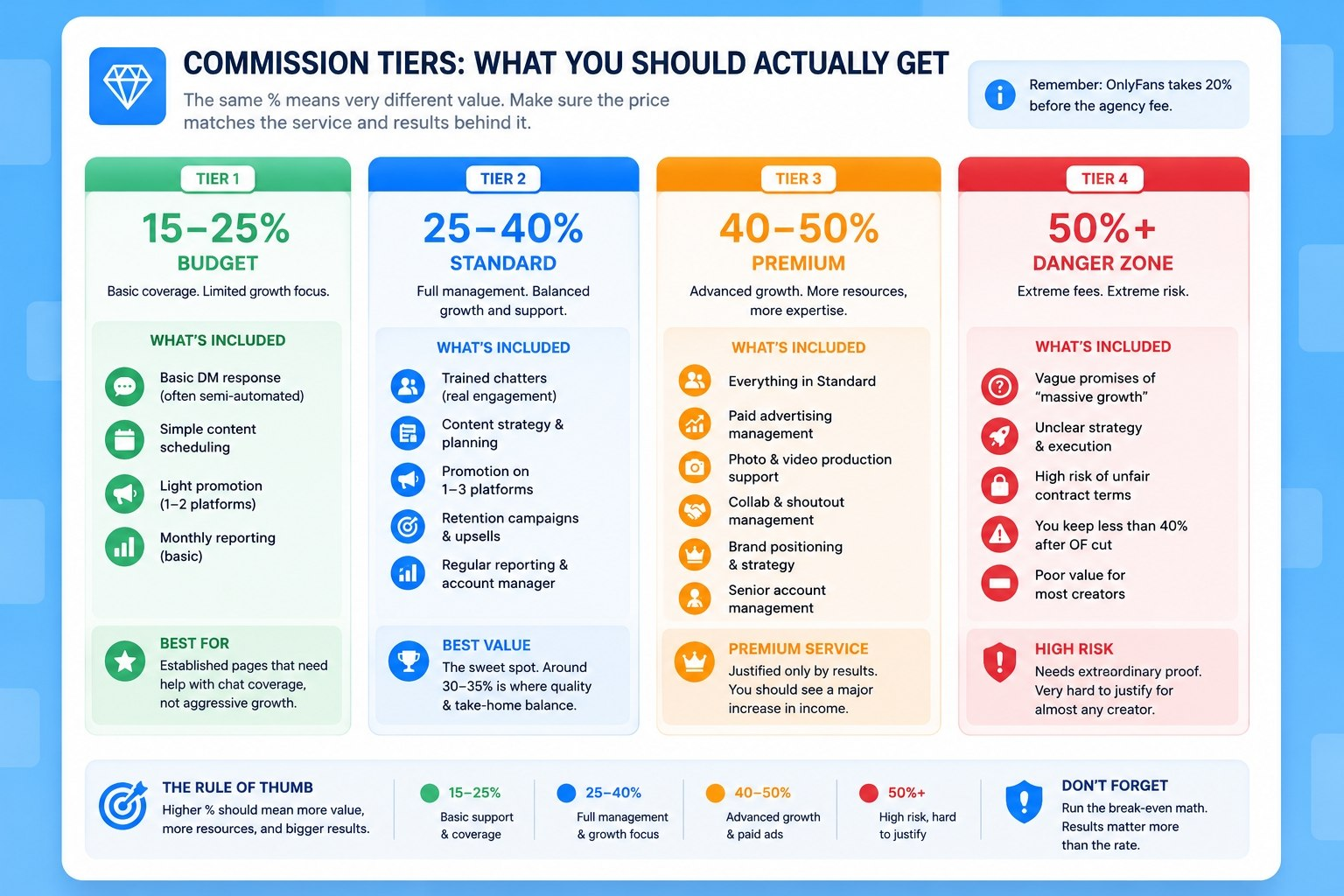
A percentage is only fair relative to the work behind it. The same 25% is a bargain for full-service management and a robbery for automated auto-replies. Here is what the market generally attaches to each band, so you can check whether an offer's price matches its scope.
| Commission | What it should include | Honest read |
|---|---|---|
| 15-25% (budget) | Basic DM coverage, often semi-automated; simple scheduling; light marketing; monthly reporting | Fine for an established page that just needs message coverage. For growth it usually underdelivers. |
| 25-40% (standard) | Trained chatters, content strategy, social on 1-3 platforms, retention campaigns, a named account manager, regular reporting | The sweet spot. Around 30-35% is where service quality and take-home tend to balance. |
| 40-50% (premium) | Everything above plus paid advertising, brand positioning, collab and shoutout management, senior management, production support | Justified only by results. If income is flat at this price, it is a premium bill for standard work. |
| 50%+ (danger zone) | Vague promises of "massive growth" | Needs extraordinary proof. With the platform's 20%, you keep under 40% of every dollar, often far less. |
Two things to notice. First, the jump from 40% to 50%-plus is where the deal stops being about service and starts being about extraction, which is exactly the band the 2026 press coverage focused on. Second, a low rate is not automatically the safe choice. A 20% agency that does nothing is more expensive in practice than a 35% one that doubles your income, because the cheap rate applied to flat revenue is money spent for no return.
Gross vs net: the clause that costs thousands
Here is the distinction most creators miss until the payouts arrive. Does the commission apply to your gross earnings, or to your net after OnlyFans has already taken its 20%? Agencies quote the same percentage either way, but the base is different, and the gap is not small.
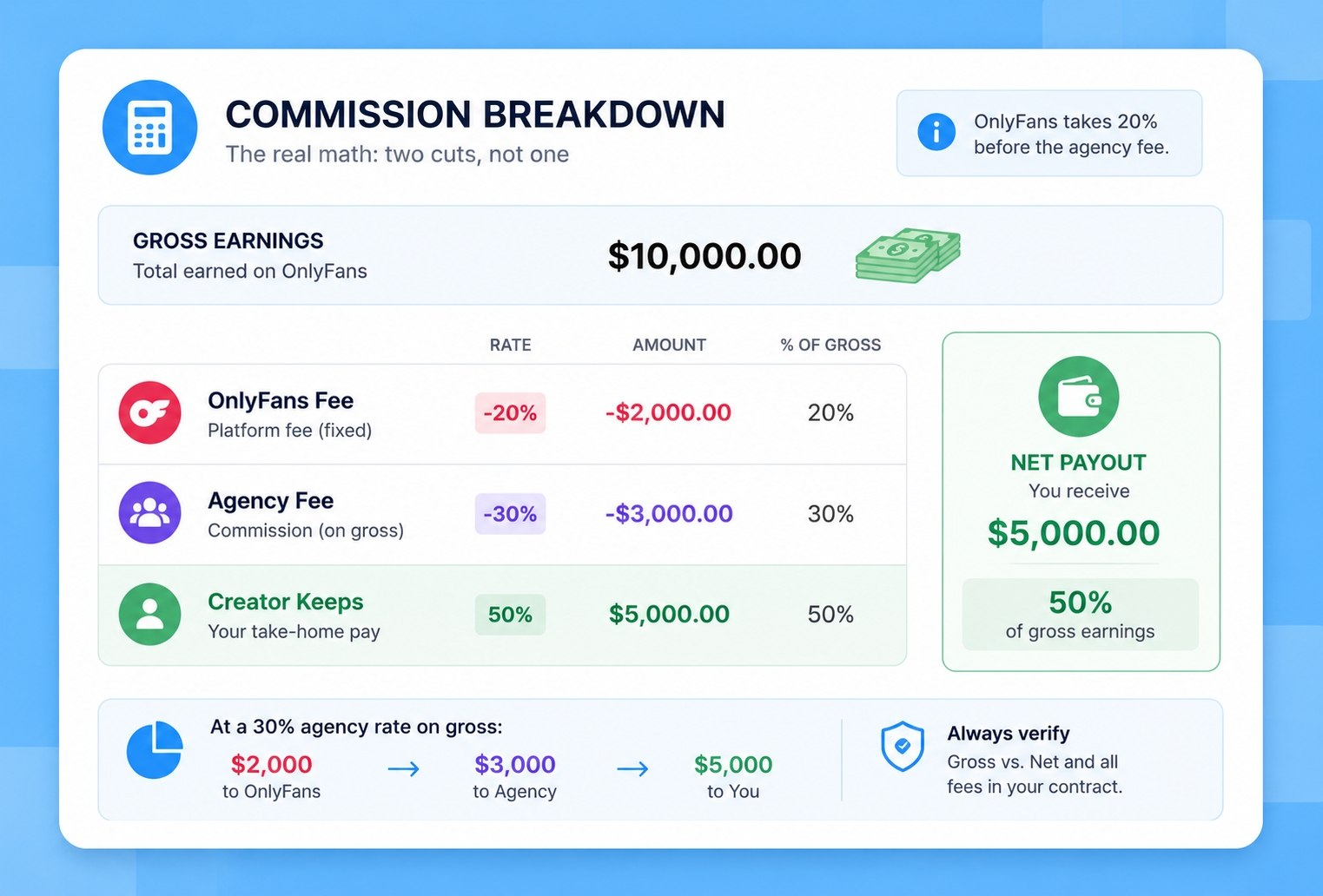
On a $10,000 month at 30% commission:
- Commission on gross: 30% of $10,000 = $3,000
- Commission on net: 30% of $8,000 = $2,400
That is $600 a month, or $7,200 a year, from one word in a contract. On a larger page the gap scales with it. Net-based commission is the creator-friendly version, because it means the agency is not taking a cut of money the platform already removed. Whichever an agency uses, the mistake is assuming. Ask the question directly, get the answer written into the agreement, and check that a sample payout statement matches the language. Any distance between what was said on a call and what appears in the document tells you how the agency will handle every future disagreement.
The hidden costs below the commission line
The commission is the fee everyone discusses. The costs that actually erode take-home are usually the ones that never come up on the sales call. Watch for these.
- Add-on line items. Some agencies bundle everything into the percentage; others charge a base commission and bill extras on top. A common pattern looks like 25% plus a $500-a-month ad budget, $300 per photography session, and a $100-a-month analytics dashboard. A 25% agency with $1,000 a month in add-ons can cost more than an all-inclusive 35% shop. Always ask for the total you will pay, every fee included, not just the headline rate.
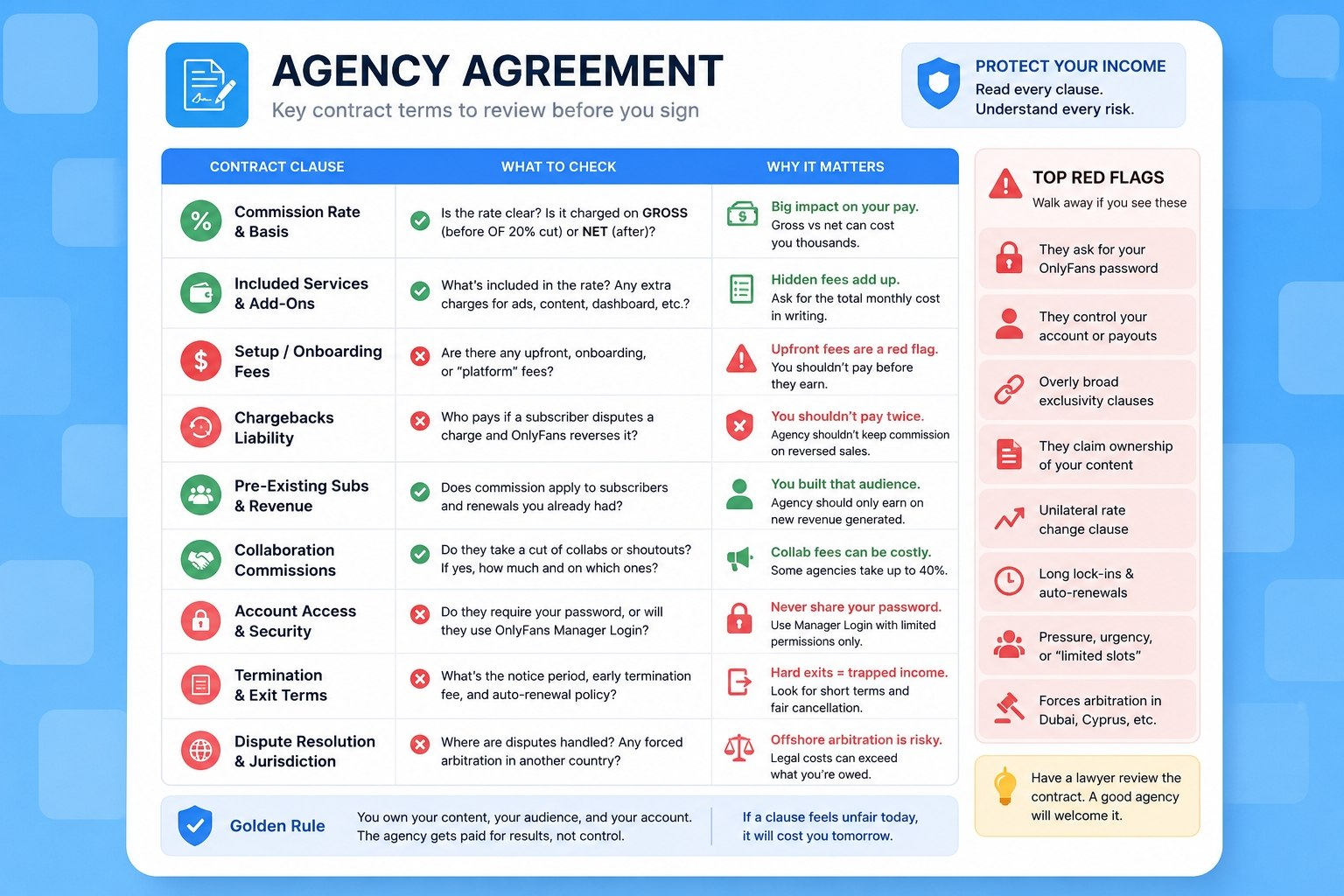
- Setup and onboarding fees. A pure commission agency charges nothing until it earns you something. Hybrid models with a production fee or a paid audit exist and can be legitimate, but every fee needs an invoice from a named entity, a written deliverable and refund terms behind it. "Onboarding fees" of $500 to $2,000, "platform fees," "technology costs," or a required "marketing budget" paid upfront with none of those are the pattern behind most scam reports.
- Chargeback liability. When a subscriber disputes a charge with their bank, OnlyFans reverses the full transaction from your earnings and does not absorb the fee. Read who eats that loss in your contract. If the agency was paid commission on the original sale but the reversal comes entirely out of your side, you cover both the lost revenue and the agency's cut of revenue that no longer exists.
- Commission on pre-existing revenue. If you arrive with subscribers and income you built solo, a fair contract commissions only what the agency helps generate from its start date. Some agreements quietly take a percentage of your existing base too. Confirm in writing that historical and renewing-subscriber revenue you brought in is excluded.
- Collaboration commissions. Some contracts claim a cut, sometimes as high as 40%, on collaboration and shoutout projects, occasionally even those involving creators the agency does not represent. That can turn a simple content trade into a taxed event. Check whether collabs sit inside or outside the commission.
- Payment routing. Ask who receives the money first. When earnings flow to the agency and it forwards your share, deductions are easier to hide and disputes harder to win than when OnlyFans pays you directly and you pay the agency. Direct-to-creator payout with the agency invoicing you is the safer arrangement.
- Exit costs and foreign arbitration. Early-termination penalties, long notice periods, and auto-renewing terms all carry a price you pay later. So does a clause forcing disputes into arbitration in Dubai, Cyprus, or an offshore jurisdiction, because the cost of enforcing your rights there can exceed what you are fighting over.
Contract red flags that cost more than the rate
The dangerous contract is rarely one dramatic lie. It is an agreement that is vague, one-sided, and hard to leave. The June 2026 BBC investigation, the documentary OnlyFans: Inside the Machine, built on testimony from 60 UK creators and undercover reporting inside a 24,000-member managers' Telegram group, put names to the worst of it: agencies taking up to 70%, changing passwords, restricting access to pages creators had built, and in some cases threatening those who tried to leave. The UK's Independent Anti-Slavery Commissioner, Eleanor Lyons, said many of the allegations matched recognized indicators of exploitation, and Ofcom called the testimony "deeply concerning."
You do not need a regulator to spot most of these before you sign. The recurring flags:
- Recovery demands. Most agencies work inside your login session, usually through a management tool, so a login request by itself is common. An agency that wants your recovery email or your two-factor device, or moves them to its own phone, is asking for the account itself. Keep both, treat the password as a key you can change, and have the contract name the tool and end access at termination.
- Account or payout control. Any term letting the agency change settings, alter your password, or sit between you and your money is a structural risk, not a convenience.
- Broad exclusivity. "Exclusive to OnlyFans" clauses that block Fansly, Fanvue, Passes, or even your own Instagram concentrate all your income on one platform and one relationship. Platform concentration is the single biggest threat to creator income.
- Content ownership grabs. "Jointly owned" or "perpetual license" language over content you make. Your content should stay 100% yours, with a limited license lasting only as long as the contract.
- Unilateral rate changes. A clause letting the agency raise its commission without your consent. A fair contract fixes the rate for the term and requires mutual agreement to change it.
- Hard exits. Long lock-ins, steep early-termination penalties, and automatic renewals that are easy to trigger and hard to escape.
- Pressure and lawyer-aversion. "Limited slots," "other creators are waiting," and any pushback on you having a lawyer review the contract. Professional agencies expect legal review; the ones who resist it are telling you something.
Is the rate fair? Run the break-even math
A percentage is fair only if the agency generates enough extra revenue to cover its own cut and then some. There is a simple way to find the line. To keep the same take-home you have now, the agency has to grow your gross to at least:
Break-even gross = your current gross divided by (1 minus the commission rate), for a rate charged on net after the platform's 20%. For a rate charged on gross, multiply your current gross by 0.8 and divide by (0.8 minus the rate).
Worked through: you earn $5,000 a month solo and an agency wants 35% charged on net. Divide $5,000 by 0.65 and you get about $7,700, a 54% revenue increase just to leave you exactly where you started. If the same 35% is charged on gross, the line moves to about $8,900. Anything above the line is the agency actually paying for itself; anything below and you are subsidizing them to run a page that was fine on its own.
This is also why the lowest rate is often the most expensive one. A 20% agency that keeps your revenue flat leaves you worse off than a 40% agency that doubles it. Run the number for every offer using its real rate and its documented, not promised, growth record. If an agency cannot point to case studies showing it clears the break-even line for creators like you, the rate is not the problem. The absence of evidence is.
Ask one more question while you are at it: what happens if you do not grow? Confident agencies answer it directly, sometimes with reduced commission in slow months or a lower rate if they miss agreed targets. A deflection is also an answer.
How to negotiate the structure, not just the number
Most professional agencies expect a terms conversation, and the commission percentage is not always the most valuable thing to move. Your leverage is highest when you already have income or an audience, when you are weighing several agencies at once, or when the agency approached you. It is lowest when you are brand new and pitching them.
What is actually on the table:
- A sliding scale instead of a flat rate, for example 40% under $10,000 a month, 35% from $10,000 to $25,000, 30% above. This aligns incentives better than any single number.
- Performance terms. A higher rate if the agency beats targets paired with a lower one if it misses. This is the healthiest structure you can ask for, because it puts the agency's pay where its promises are.
- Included scope. If the rate will not move, push for more services at the same rate, or for setup fees and add-on charges waived.
- A shorter first term. A brief trial commitment, even at a slightly higher rate, lets you test delivery before locking in.
Say it plainly: you want the financial structure to work for both sides, and you are asking whether there is flexibility on the percentage or room for a performance-based sliding scale. An agency that refuses to discuss any of it is showing you how every later negotiation will go.
Before you sign: a due-diligence checklist
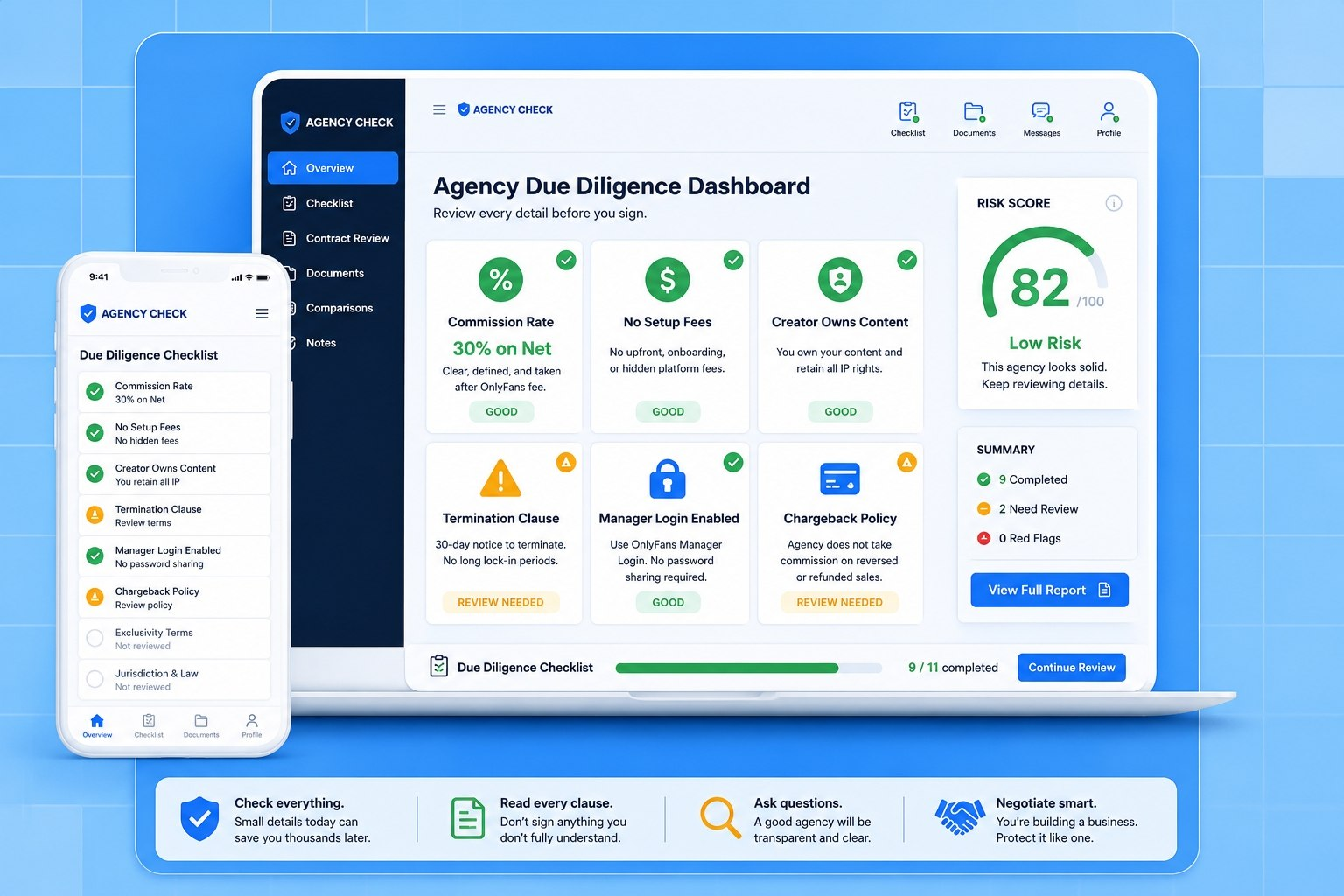
Run every offer through this before committing. If an agency stalls on any line, treat the hesitation as data.
- What is the commission rate, and is it charged on gross or on net after the platform's 20%? Get the answer in the contract.
- What is the total monthly cost including every add-on, ad budget, and dashboard fee, not just the headline percentage?
- Are there any upfront, onboarding, setup, or "platform" fees, and what invoice, deliverable and refund terms stand behind each one?
- Who is liable for chargebacks, and does the agency refund its commission on reversed sales?
- Does commission apply to subscribers and renewals you brought in yourself? (It should not.)
- Is content ownership 100% yours, with only a term-limited license to the agency?
- Do you keep the login email and the two-factor device, with the agency's access named in the contract and ended at termination?
- Does the contract allow the agency to change the rate unilaterally? (It should not.)
- What are the exit terms: notice period, early-termination penalty, auto-renewal, and dispute jurisdiction?
- Can the agency show documented results that clear your break-even number for creators at your stage?
- Will a lawyer review it, and does the agency welcome that?
Glossary
- Gross earnings: everything a page brings in before any deduction, the base most agency commissions are calculated on.
- Net earnings: what remains after OnlyFans takes its 20%, the creator-friendlier base for a commission.
- Commission on gross vs net: whether the agency's percentage is applied before or after the platform cut; the difference can run into thousands a year.
- Pure commission: a flat percentage of earnings with no fixed fee.
- Tiered commission: a rate that steps down as monthly earnings rise.
- Flat fee / retainer: a fixed monthly charge independent of revenue.
- Hybrid: a smaller retainer combined with a lower commission percentage.
- Chargeback: a bank-initiated reversal of a subscriber's payment, which removes the full amount from creator earnings.
- Account access: how the agency operates your page, usually through your login session inside a management tool; the recovery email and two-factor device should stay with you.
- Break-even gross: the revenue an agency must reach to leave your take-home unchanged; for a rate charged on net, your current gross divided by one minus the rate, and higher when the rate is charged on gross.
Frequently asked questions about OnlyFans agency fees
How much do OnlyFans agencies charge in 2026?
Most work on commission, commonly 20 to 40% of gross earnings, with the industry settling around 30% for full-service management. Budget shops run 10 to 25% for chat-only coverage, premium ones 40 to 50% for paid ads and production, and rates above 50% are hard to justify. Remember the number sits on top of OnlyFans' own 20%.
What do OnlyFans creators actually keep after all fees?
On a 30% agency deal charged on gross, you keep 50% of what your page earns: 20% goes to the platform, 30% to the agency. On a 50% deal you keep 30%. The exact figure depends on whether commission is charged on gross or net, and on any add-on fees stacked on the percentage.
Are agency fees charged before or after OnlyFans takes its cut?
It depends entirely on the contract, which is why you have to ask. Some agencies charge on gross (before the platform's 20%), others on net (after). On a $10,000 month at 30%, that choice is a $600 difference, so confirm it in writing.
What hidden costs should I watch for?
Setup or onboarding fees, ad-budget and dashboard add-ons billed on top of commission, chargeback liability landing entirely on you, commission on subscribers you already had, collaboration commissions, and early-exit penalties. A pure commission agency charges nothing upfront; any fee needs a deliverable, an invoice and refund terms behind it.
Is it a red flag if an agency wants my OnlyFans password?
A login request on its own is how most agencies work today; the warning sign is a demand for your recovery email or your two-factor device, or an agency that changes them. Handing over recovery is what the 2026 BBC investigation tied directly to account takeovers. Keep both, and change the password when the contract ends.
How do I tell if a commission rate is fair?
For a rate charged on net, divide your current monthly gross by one minus the rate to find the revenue the agency must reach just to keep your take-home flat. At 35% on a $5,000 page, that is about $7,700, a 54% increase; at 35% charged on gross, about $8,900. If the agency cannot show documented results above that line for creators at your stage, the rate is not earning its keep.
Related insights
Compare your options
Browse agency rankings or compare tools for creator teams.